
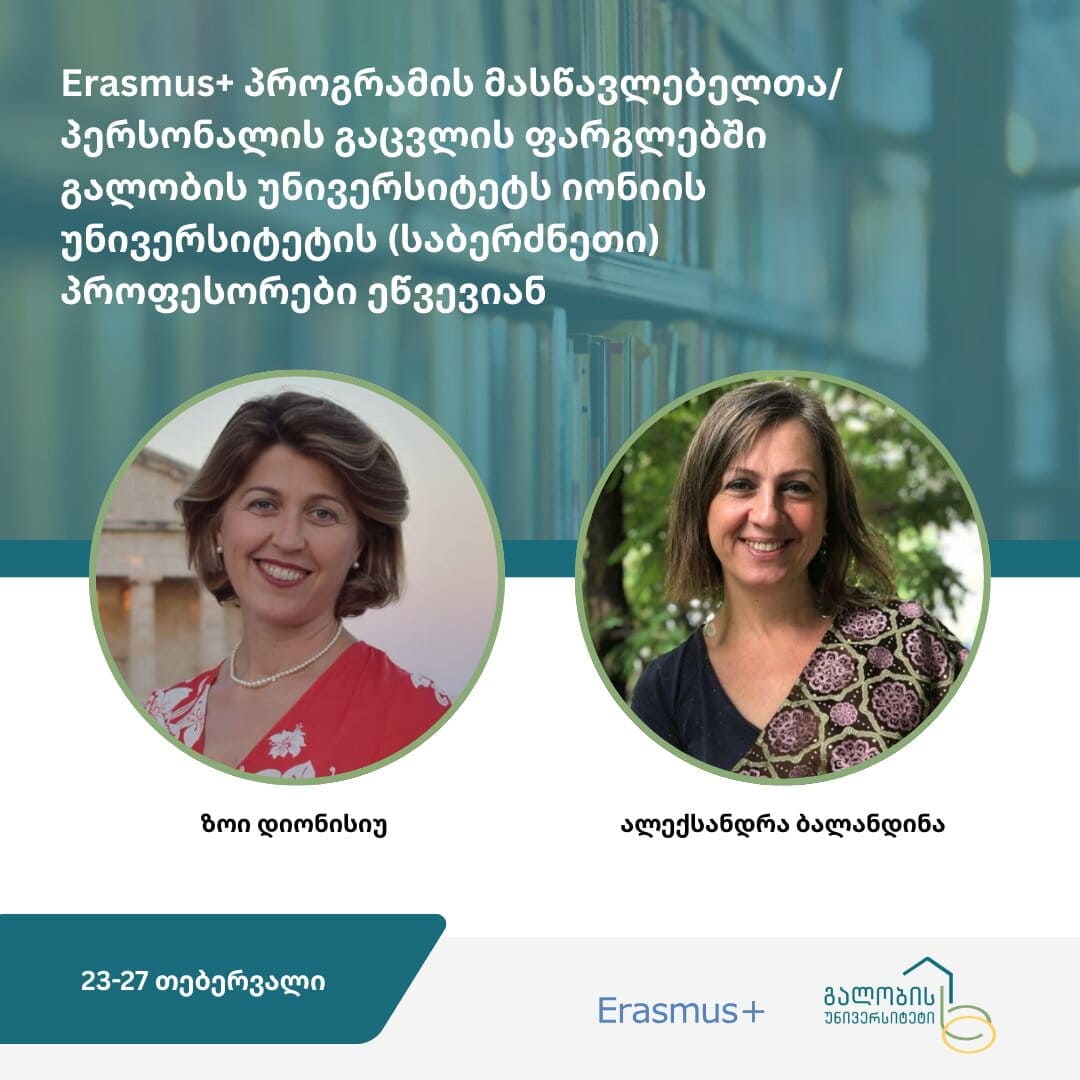
We are pleased to announce that professors Zoe Dionyssiou and Alexandra Balandina, from Ionian University, School of Music and Audio-Visual Arts, Department of Music Studies (Greece) will visit the University of Chant within the framework off Erasmus+ teacher / staff exchange. The planned teaching / training week would take place between 23-27 February 2026.
Zoe Dionyssiou is Professor of Music Education at the Department of Music Studies, Ionian University, Greece. She studied Education (Department of Early Childhood Education, Aristotle University of Thessaloniki), and she holds an MA and PhD in Music Education from the Institute of Education, University of London. She is the Director of the MA Program “Music Pedagogy” at the Ionian University (2016-now). She has been academic co-ordinator of the Post-graduate Training Program “Music in Early Childhood Education” (Centre for Life Long Learning, Ionian University) and academic co-ordinator of the Ionian Summer Academy in the field of music education.
Greek Rebetika Songs and their educational and social value for young people today: Critical pedagogy in action
Rebetika is an urban popular music genre with roots in music of Asia Minor that developed in the 1920s at the harbour of Piraeus, known as the blues of Greece. My research is centred on the educational and social value of rebetika for young people today and focuses on a project that took place this year by university students that visited and performed rebetika in secondary schools of Corfu. I also refer to issues of Critical Pedagogy and in what ways can rebetika be relevant to young people today.
Teaching Greek traditional songs and singing games through the framework of Intercultural music education and World Music Pedagogy
A framework of intercultural music education will be presented, which draws from World music pedagogy, Intercultural music education and Culturally responsive teaching. Participants will be introduced to a bunch of Greek traditional songs and singing games that will be performed-played as examples to intercultural music pedagogy.
Alexandra Balandina is Associate Professor of Ethnomusicology at Ionian University, Greece. Graduated from the department of Social Anthropology, Panteion University of Athens, Greece and earned MMUS in Ethnomusicology and PhD in Ethnomusicology from the Music Department, Goldsmiths’ College, University of London, under the supervision of Prof. John Baily. Born in Tashkent, Uzbekistan, speaks Russian, Farsi, Greek, Macedonian and Serbian.
Traditional Urban Music Genres in Greece: Café Aman, Rembetiko and Laiko.
This presentation explores the evolution of traditional urban music in Greece, focusing on Café Aman, Rebetiko, and Laïko. We will examine their historical and social contexts, key musical characteristics, and the ways they have shaped and been shaped by urban life. Through audio examples and discussion, we will trace the continuity and transformations of these genres from the late Ottoman era to contemporary Greece.
Research methods in ethnomusicology
This presentation demystifies each step of an ethnographic research process. It discusses how to craft a research plan and write a research proposal, what it means to engage in participant observation and arts-based research as an embodied scholar, how to write field notes and conduct interviews, the importance of music transcription and audiovisual research methods in ethnomusicology, and the consideration of ethical issues at all stages. Through discussions of emerging concepts such as embodied and sensory research, methodological reflexivity, researchers’ positionality, ethnographic listening, and fieldwork in uncertain times, it engages with the embodied,affective, ethical, and intellectual dimensions of ethnographic fieldwork.